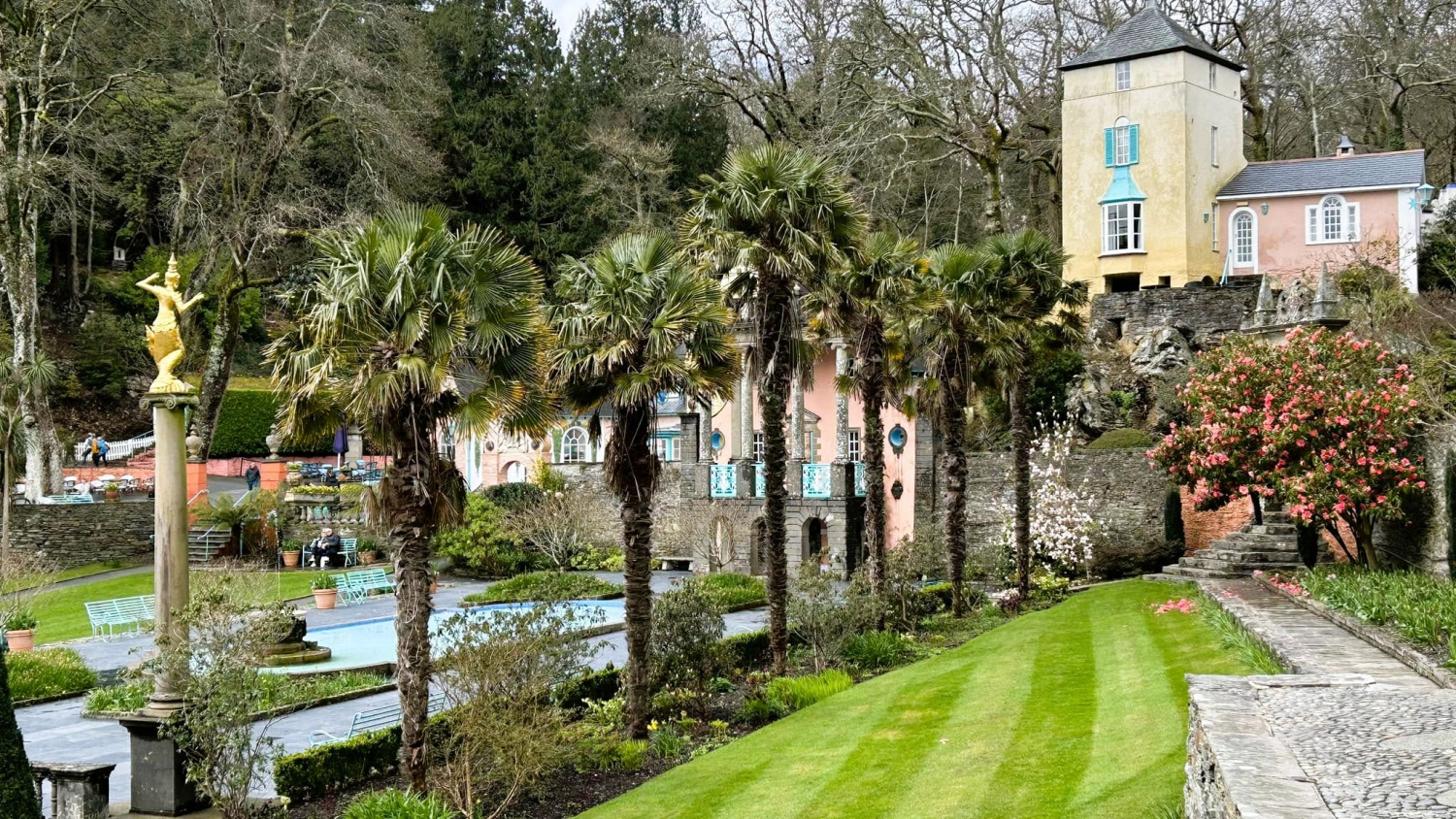
The approach gives nothing away. You turn off at Minffordd, past a caravan park and a wall of rhododendron, and pay at a toll booth in the manner of a man buying a parking ticket. Then a lane drops through dripping woodland with the estuary flickering somewhere below and to the left. There is no announcement. The trees simply stop.
What is then in front of you is a bell tower the shade of clotted cream, seven storeys of it, standing above a piazza on the edge of Tremadog Bay. Below and around are a domed rotunda, a colonnade that used to be in Bristol, a gothick pavilion, cottages in coral and turquoise and lemon, a Jacobean town hall, a lighthouse, and a vessel moored at the quay which turns out, as you get closer, to be made of stone. Beyond all of it lie four miles of tidal sand, the colour of a biscuit, and then Snowdonia.
People have been having this experience for a hundred years. The old house on the shore opened as the Hotel Portmeirion on Good Friday, 2 April 1926, and the whole enterprise is accordingly spending 2026 in a state of well-organised celebration: a 1920s house party at Easter, the Six of One convention in April, a steampunk weekend in May, and four one-day concerts on the fields below Castell Deudraeth. Two of those remain as we go to press — Hafwyl on 22 August, with 9 Bach and Bob Delyn a'r Ebillion, and Jools Holland on the 29th. Penderyn has produced a commemorative whisky finished in Amarone casks and named, inevitably, The Village. Sarah Baylis has produced the centenary history, Portmeirion: The Architecture of Pleasure, which is very good and full of people nobody has written about for fifty years.
The man in the yellow stockings
The architect was Bertram Clough Williams-Ellis, known to everyone as Clough, and he is the reason the place exists in more or less the way a weather system is the reason for rain. He had decided at five or six that he would be an architect. He spent the early 1920s looking for a bay or an island on which to build a village of his own, considered sites abroad, and eventually found what he wanted on a run-down estate belonging to his uncle, five miles from the family house at Plas Brondanw. He bought it in 1925, renamed it — Aber Iâ, the ice estuary, became Port plus Meirion for Merioneth — and started building. He stopped in 1939, resumed in 1954, and was still adding to it in his nineties. He died in 1978, aged ninety-four.
He was not a modest man and he did not pretend to be. In late middle age he settled on a permanent costume of knee breeches, canary-yellow woollen stockings, a matching waistcoat, a tweed jacket and an outsize bow tie, and wore it more or less unvaryingly for the next four decades, including while hand-gilding a finial from a ladder at the age of seventy-five. Visitors came partly to see the buildings and partly to see him. His campaigning books, England and the Octopus of 1928 and Britain and the Beast of 1937, made him one of the loudest voices against what he called bungaloid growth, and he was a founder of the bodies that became the CPRE and its Welsh counterpart. His motto — cherish the past, adorn the present, build for the future — appears on his work in the tone of a man who expects to be quoted.
The plaque at the foot of the campanile gives the flavour better than any biography. It records that the tower was built by Clough Williams-Ellis, architect and publican, and that it contains stone from the twelfth-century castle of his ancestor Gruffydd ap Cynan, King of North Wales; the castle having been demolished around 1869 by Sir William Fothergill Cooke, inventor of the electric telegraph, in Clough's telling lest the ruins should become known and attract visitors to the place. Every word of that is a small act of revenge, and the reader is meant to notice.
Nothing thrown away
Clough called the settlement a home for fallen buildings, and the phrase is exact. Portmeirion is substantially made of other people's demolished houses, acquired at a period when nothing whatsoever protected them.
The best of the rescues is the town hall. Hearing that Emral Hall in Flintshire, seat of the Puleston family, was to come down, he asked the National Trust to save it; they declined. He asked the Victoria and Albert Museum; they declined too. He then got on a train, arrived while the fittings were being auctioned off, and bought the great chamber's early seventeenth-century plasterwork ceiling — the Labours of Hercules and the signs of the zodiac, worked in bold strapwork, a ceiling that Cadw now ranks with Hardwick and Lanhydrock — for thirteen pounds. His men sawed it into roughly a hundred pieces, carted it to Wales, and put it back together inside a new building along with Emral's carved stonework, mullioned windows and Tudor doorways. The result was listed Grade I. It is now used for weddings.
The same instinct produced the rest. The Bristol Colonnade came from Arnos Court. The facade of the Dome began life as the upper part of a Norman Shaw fireplace. There are carved Burmese dancers, and eroded but authentic urns pursued from elsewhere, and a great deal of concrete left frankly bare because he liked the honesty of it. Frank Lloyd Wright, visiting the country of his ancestry for the only time, admired precisely this — the nerve of combining so many idioms and getting away with it. Architectural historians spent decades filing the place under idiosyncratic playground of little interest. They have gradually come round, and the post-modernists, who arrived forty years later doing something similar with less charm, owe it more than they generally admit.
Blithe spirits
The guest book is where a hospitality writer starts to enjoy herself. Bernard Shaw came. H. G. Wells came. Bertrand Russell, who lived along the road at Plas Penrhyn, was a fixture. Uriah Lovell, a Romany basket weaver, lived in a bender tent in the woods and was part of the establishment. George Harrison spent his fiftieth birthday here.
Then there is Noël Coward. In 1941, his London flat and office destroyed in the Blitz, he took a short holiday at Portmeirion with the actress Joyce Carey, installed himself in the Upper Fountain suite, chain-smoked for about a week, and emerged with the whole of Blithe Spirit. It opened in the West End that year and ran for 1,997 performances, a record for a non-musical play in London. A ghost comedy, written at speed, in a place assembled from the remains of dead houses, during a war: one hesitates to make too much of it, but Coward would have.
The other cultural export was less welcome to its landlord. Patrick McGoohan had filmed a Danger Man episode here in 1960 and remembered the site; when he came to make his own series he brought the crew back in September 1966 and turned Clough's arcadia into a place from which no one is permitted to leave. The Prisoner used the piazza, the hotel, the Gwyllt paths and the beach, with the interiors shot at Borehamwood. Rover, the white sphere that hunts down escapers, was a weather balloon somebody spotted floating above the village, dragged about on wires. The show has never gone away. The appreciation society, Six of One, was formed in 1977 and still descends every spring in blazers and piped capes; there is a shop devoted to it and a self-guided location map at the welcome centre. Purists grumble that the series has swallowed the architecture. It has certainly doubled the audience.
Clough's elder daughter, meanwhile, provided the third fame. Susan Williams-Ellis took over her father's souvenir shop after the war, bought a small Stoke decorating firm in 1960 with her husband Euan Cooper-Willis, and in 1972 launched Botanic Garden, based on hand-coloured plates from Thomas Green's herbal of 1817 that she had come across at a London antiquarian bookseller while hunting for engravings of sea creatures. Buyers told her nobody would stock a service where no two pieces matched. It has been in continuous production for over fifty years and pays for a great deal.
Going
Give it a night. The gates shut at half past six through the main season, the coaches pull away, and the seventy acres — the piazza, the Gwyllt with its tree ferns and camellias, the estuary path, the whole absurd, exact composition — belong to whoever is staying. This is the single piece of advice worth giving about Portmeirion, and it is the difference between an outing and a memory.
Clough held that a beautiful place could be developed without being spoiled, and built a hundred years of evidence to prove it. That the evidence takes the form of a Welsh peninsula wearing Italian dress, with a Jacobean ceiling indoors and a stone ship at the quay, is not a flaw in the argument. It is the argument.
Fifteen things guides don't mention:
The woman who read sermons to her dogs
Before Clough Williams-Ellis, the peninsula was Aber Iâ, and its tenant was Mrs Adelaide Haig — the surname also appears as Haigh — who lived in the mansion on the shore from 1870 until her death in 1917 and preferred dogs to people. She is said to have kept a large pack, housed them in one of the bedrooms, and read sermons aloud to them in the belief that they shared her faith. She let the drive grow over so completely that when she died the hearse could not reach the house until a path had been cut. She buried her dogs in the woods, with headstones and effusive epitaphs. The Dogs' Cemetery is still there, still in use, and still receiving visitors who came looking for the piazza and found something considerably stranger.
The gardens are older than the village
The Gwyllt — the Wild Place — was planted well before 1925 by George Henry Caton Haigh, an authority on Himalayan trees and one of the serious rhododendron men of the early twentieth century. The peninsula is effectively frost-free, so camellias, tree ferns and gunnera behave as though they were somewhere else entirely. Seventy acres, some nineteen miles of path, and a good deal of it older than anything with a roof.
The village was a wedding present of sorts, via a mud cottage
Clough met Amabel Strachey through her father, John St Loe Strachey, proprietor and editor of The Spectator, who was preoccupied with housing the poor cheaply and had run a competition to build a good, cheap cottage out of rammed earth. Clough took up pisé construction with him at Newlands Corner. They married in 1915, while he was on leave.
Lady Williams-Ellis was the more published of the two
Amabel wrote something upwards of forty books — some counts put it above seventy — including novels, children's books, histories, and anthologies of folk tale, fairy story and science fiction. She was literary editor of The Spectator in 1922–23. In Who's Who she recorded two facts about her career: that post, and that she was educated at home. She reviewed Shaw in 1914 and called him dull. She described herself as a class traitor, was an active member of the Independent Labour Party alongside her brother John Strachey, later a minister under Attlee, and her memoir of 1983 was titled All Stracheys Are Cousins. Her father, it is said in the family, sold the paper rather than see it become a platform for his left-wing children.
He never qualified
Clough read natural sciences at Trinity and did not graduate. His formal architectural training amounted to three months at the Architectural Association in 1902–03. He then designed, over the following seventy years, an Italianate village, a good deal of Stowe, and cottages from Oxfordshire to County Antrim, and was knighted for it in his late eighties.
Well-known in the club 'Atters', Michael Attree, grew up in one of his Oxfordshire houses.
Captain, MC
He served in the First World War with the Welsh Guards, latterly as an intelligence officer attached to the Tank Corps, and was awarded the Military Cross in the 1918 New Year Honours. He and Amabel later co-wrote a history of the Tank Corps. The couple's youngest child, Christopher — Kitto — was killed in Italy in March 1944, before Monte Cassino, and lies at Minturno.
Thirteen pounds
The Hercules ceiling in the town hall is early seventeenth-century plasterwork from Emral Hall in Flintshire: the Labours of Hercules and the signs of the zodiac in bold strapwork, ranked by Cadw with Hardwick and Lanhydrock. Clough asked the National Trust and the V&A to rescue it, and after being refused, went to the auction and bought the ceiling for £13. It was sawn into roughly a hundred pieces and rebuilt in Wales.
Dome deficiency
The Pantheon of 1961 exists because Clough looked at what he had built and diagnosed the settlement as suffering from what he called dome deficiency. The facade of the Dome, meanwhile, began life as the upper portion of a Norman Shaw fireplace; the colonnade came from Arnos Court in Bristol; the gothic pavilion was a gift from Nercwys Hall in Flintshire.
The golden Buddha is a film prop
The gilded Buddha sheltered in the village came from the production of The Inn of the Sixth Happiness, the 1958 Ingrid Bergman picture shot in Snowdonia, and was handed over to Clough when filming ended. He was constitutionally unable to refuse a large object nobody else wanted.
And so is the shortfall on St Peter's canopy
Guides on site may tell you that the canopy above the statue of St Peter at Battery Square is smaller than intended because the foundry misread the measurements. It was installed regardless. This is either a charming anecdote or the whole design philosophy in miniature, depending on how the day is going.
Look for the scallop shells and the camera obscura
The grotto is lined with scallop shells gathered off the beach below. The Observatory Tower contains a camera obscura. Neither is signposted.
Nobody lives here
Portmeirion has no permanent residents, no council, no school and no bank. The town hall is called a town hall because Clough wanted one, not because there is any municipal function for it to discharge. The whole estate is now held in a charitable foundation and cannot be sold.
The Beatles connection is longer than the anecdote suggests
George Harrison spent his fiftieth birthday here, which is the fact everyone repeats. Local accounts hold that Brian Epstein had the Gatehouse for some seven years — though this remains a rumour.
Rover was a weather balloon somebody happened to see
The white sphere that hunts down escapers in The Prisoner was inspired by a weather balloon spotted drifting above the village by the production manager. It was hauled about on wires, which are visible in several shots if you are the sort of person who looks. McGoohan had already filmed a Danger Man episode here in 1960; he came back with his own crew on 5 September 1966.
He went up in a rocket
Clough died in April 1978, aged ninety-four, and was cremated. Twenty years afterwards, a portion of his ashes was packed into a marine rocket and fired over the Dwyryd estuary as part of a New Year's Eve display. There is no better summary of the man, and it is a matter of record rather than legend.
Recommended reading: Sarah Baylis, Portmeirion: The Architecture of Pleasure (2026); Jonah Jones, Clough Williams-Ellis: The Architect of Portmeirion; and Clough's own Portmeirion: The Place and Its Meaning, still the best guide to what he thought he was doing. Amabel's All Stracheys Are Cousins (1983) is out of print but worth the hunt.
Comments (0)
No comments yet.
Commenting is for subscribers. Sign in or subscribe to join the conversation.