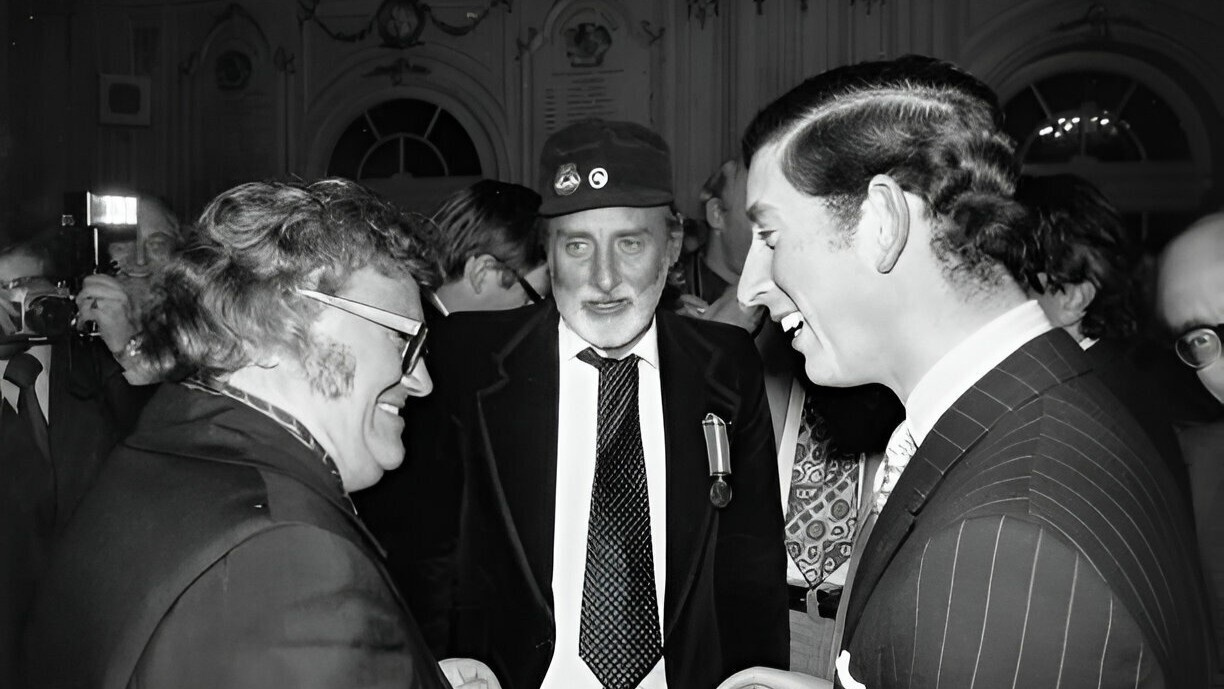
When the Prince of Wales — now, of course, the King — arrived to the Eccentric Club on the evening of the 29th of November 1973, it was to keep company with a trio of grown men who had built glittering careers out of exploding sound effects, imaginary flea circuses and a character who communicated chiefly by falling into water. He could not, by every surviving account, have looked more delighted about it.
The pretext was a book. More Goon Show Scripts, Spike Milligan's second printed helping of the radio nonsense that had ended its run in 1960, was being launched into the world, and the Prince had done rather more than accept the invitation: he had written the foreword. It is a small masterpiece of the fan's art, saluting the Goons' particular genius as "mental slapstick and imaginary cartoonery" — a phrase one suspects he had been polishing since prep school. The volume itself was the follow-up to the previous year's Goon Show Scripts, and gathered eight of the show's finest half-hours from its ninth series, Ned's Atomic Dustbin and The Battle of Spion Kop among them, reproduced down to the last direction for agonising knuckle-cracking. That the heir to the throne had supplied its opening pages was the sort of endorsement no publisher's account could buy and no press agent could feign.
He was received that night by Milligan himself and by Sir Harry Secombe, and the photographs — dated, as press images always are, to the following morning — capture something one does not often see in a royal engagement: a future monarch entirely off duty, entirely at home, laughing at jokes he plainly knew by heart. For this was no dutiful patronage. The Prince had grown up doing the voices, to the visible unease of a succession of tutors, and had never troubled to stop. When the Goons reconvened in 1972 for The Last Goon Show of All, marking the BBC's half-century, naval duty kept him at sea; he wired his regrets and sent Prince Philip and Princess Anne to occupy the stalls in his stead. He had even, while with the RAF, committed a small Goonish film of his own to celluloid, solemnly billed as a Royal production. One does not do these things for form's sake. One does them for love.
The affair was, happily, requited — and it did not end at Ryder Street. Almost a year to the season later, on the 11th of November 1974, the Prince dined with his heroes again, this time beneath the chandeliers of the Dorchester, at another celebration of the Goons in print. The cast list had rearranged itself with a symmetry Milligan would have adored: he was there, and so were Peter Sellers and the elusive Michael Bentine, the Anglo-Peruvian who had wandered off from the team back in the fifties — while poor Secombe, who had done the honours in 1973, was this time confined to bed with a chill. The comedians met the royal arrival with the full arsenal: cries, capers, and Milligan pulling faces behind Bentine's back like a boy who has never once been sent to the headmaster. His Royal Highness, one is reliably told, adored every second.
From there the attachment simply refused to fade. When he married at St Paul's in 1981, Milligan was among the guests — immortalised, gloriously, in a photograph of the great man sprinting down the road in morning dress, terrified of arriving after the bride. Milligan, for his part, returned the devotion in the only coin he trusted, which was cheek. At the British Comedy Awards of 1994, as Jonathan Ross stood reading out a fond letter from the Prince — who confessed on air to a lifelong weakness for the Goons, first contracted from the "steam-driven wireless" of his boyhood — Milligan listened with handkerchief in hand, then cut clean across the eulogy to pronounce his royal admirer a "grovelling little bastard". The nation gasped; the studio adored it; and the next morning the culprit faxed His Royal Highness to wonder whether "a knighthood is out of the question?" It was not. The honorary title arrived in 2001, a year before he took his leave beneath the finest epitaph in Christendom: I told you I was ill. The Prince, meanwhile, had in 1998 become patron of the Goon Show Preservation Society, and keeps the office still — now from the throne, the fandom as incurable as ever.
And yet the moment that lingers longest is the gentlest. In November 1996, as Bentine lay dying at the Royal Marsden, the Prince came to sit with him — no ceremony, no cameras, half an hour of company — for no grander reason than to say thank you, after all those years, for the laughter. There is a motto that hangs over this club and everything it does, and rarely has it been better honoured: nothing but good, said of a Goon while the Goon could still hear it.
One likes to picture the whole enchantment as it began, on that first November night among our members: the earnest young Prince and the mercurial Irishman bent together over a paperback that existed only because a wireless programme had once made a nation helpless — and had made this particular listener, a small boy in a very large palace, feel for half an hour that the world was not so heavily governed after all. It is the best thing a club can ever host. Not an engagement. A welcoming homecoming.
...The ghost of our clock in the bar keeps its own contrary time, as it always has. The Goons would have approved. So, one rather suspects, does the King.
Nil Nisi Bonum.

Comments (0)
No comments yet.
Commenting is for subscribers. Sign in or subscribe to join the conversation.