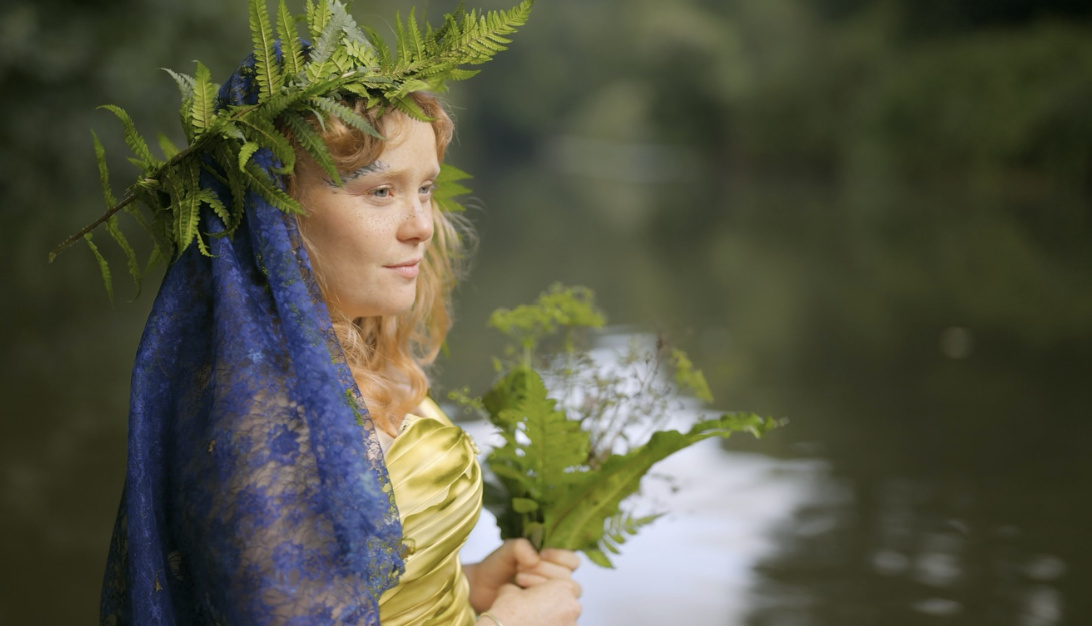
Bath and North East Somerset Council has voted to recognise the rights of the River Avon. The motion's most persuasive advocate is the woman who married it.
On 16 July, in the council chamber at Bath, a woman rose to address the elected members on behalf of her husband. He was unable to attend in person. He is eighty-three miles long, he rises in Gloucestershire, and he discharges into the Severn estuary at Avonmouth.
Mrs Meg Avon — born Megan Trump, of Bristol, poet, researcher, wild swimmer and self-described imagination activist — married the River Avon on 17 June 2023, on its banks, before witnesses, with a celebrant, Ruth Sidgwick, officiating. She wore a dress. There were vows, and the vows were the entire point: she promised to protect her beloved, and invited everybody present to promise the same. She took his name, as brides once did without remark, and has kept it. She swims in him every week, through the winter as well, and reports that the two of them remain, in her own phrase, "very much in love." She marked the third anniversary this year.
The registrar of Bristol has, needless to say, no record of the union. This has not slowed her down.
Desponsamus te, mare
The English are inclined to treat this sort of thing as a joke, and it is a joke — Mrs Avon is a performer, and a funny one, and the humour is doing deliberate work. But the marriage of a person to a body of water is a good deal older and grander than a Bristol riverbank in June. Every Ascension Day for the better part of eight centuries, the Doge of Venice was rowed out into the lagoon aboard the Bucintoro and dropped a gold ring into the Adriatic with the formula Desponsamus te, mare, in signum veri perpetuique dominii — we wed thee, O sea, in token of true and perpetual dominion.
Venice understood precisely what it was doing. A wedding is a claim of relationship, and a relationship carries obligations in both directions. The Doge married the Adriatic in order to be answerable to it, and to oblige everybody watching to be answerable too. Mrs Avon has discarded the dominion and retained the obligation, which is arguably an improvement on the original.
There is a further pleasure available to the pedant. Avon descends from the Brythonic afon, meaning, simply, river. Mrs Avon is therefore Mrs River, wedded to the River River, a tautology of such completeness that one hesitates to disturb it.
The vote
What she brought to Bath, however, was not romance but a document. The charter for the Avon bioregion, promoted by the campaign group We Are Avon, asks local authorities to recognise that the river possesses rights: to exist, to flow sustainably, and to be free of contamination. On 16 July the members of Bath and North East Somerset voted for it unanimously. Not a single dissent. Speaking in the public session, Mrs Avon told the chamber that acknowledging such rights was hardly a radical act. "Humans and nature are not separate, we are together."
The motion was tabled by Councillor Andy Wait of Keynsham East, who wants every authority along the watercourse — unitary, town and parish alike — to sign from source to sea. One already has: Winsley Parish Council, in Wiltshire, on the sensible reasoning that the flow passing Winsley is the same flow that reaches Bath a few hours afterwards. The precedent is the Wye, which in May became the first British river to have every council along its entire length committed to a charter of its own. We Are Avon reports 120 river guardians in the field and some 260,000 acres of bioregion under observation.
The ledger underneath
Beneath the ceremony lies a thoroughly unromantic ledger. Councillor Oli Henman of Walcot called it shocking that people swimming in the Avon have been falling ill. Daisy Thompson, a mother from East Harptree, told the chamber that the water recycling centre near her home had discharged into the neighbouring brook for more than a thousand hours last year; that brook feeds the Chew, and the Chew feeds the Avon. She no longer lets her children go in.
Conham Bathers, another group to which Mrs Avon belongs, applied for designated bathing water status on a popular stretch and was refused, the quality being too poor to qualify — which is to say that a river cannot be officially swum in because of what is in it, a sentence that ought to detain somebody in Whitehall for an afternoon. The resolution now obliges the council to review what it can do about water quality and biodiversity, and instructs its leader to convene regular meetings with Wessex Water on the subject of untreated sewage.
None of this is unprecedented in law, incidentally. Ecuador wrote the rights of nature into its constitution in 2008. New Zealand granted legal personhood to the Whanganui in 2017, complete with two appointed guardians to speak on its behalf. The idea can be traced at least to Christopher Stone's essay of 1972 asking whether trees should have standing. British councils are conferring nothing so muscular, and a charter of this sort binds no one at all. What it alters is the register of the conversation: the Avon ceases to be a drainage feature and becomes an entity with interests, which is precisely the shift that precedes every change in the law that has ever mattered.
The Club's verdict
Which brings us to the lesson, and it is one this magazine holds dear.
Eccentricity is not the opposite of seriousness. It is frequently seriousness that has exhausted its patience with the conventional routes.
A petition earns a receipt. A press release earns a paragraph on page nineteen, beneath the fixtures. A woman in a wedding dress standing waist-deep in the Avon and promising to love, honour and defend it earns a feature documentary — Rave On For The Avon — a national tour of Q&A panels, a permanent change of surname, and, three years afterwards, a unanimous vote in a chamber that had heard the arguments many times before and had not, until she walked in, done a great deal about them.
The Club has never maintained that eccentricity is an end in itself. The finest specimens of it are method: the calculated absurdity that achieves a serious object once the sensible approaches have all been tried and found wanting. Judged by that standard, Mrs Avon belongs among the more accomplished practitioners now at work in these islands.
We wish the couple every happiness, and the groom a swift recovery.
Sources: Local Democracy Reporting Service (John Wimperis), 22 July 2026; SWNS; Powerhouse Talent Management; the Opening Ceremony podcast.

Comments (0)
No comments yet.
Commenting is for subscribers. Sign in or subscribe to join the conversation.