The invitation arrived on a blue card with a Magritte sky, and it was illegible. The words ran backwards. To learn where one was going, and when, and what to wear, one had first to walk to the looking-glass and hold the card up to it. Un Dîner de Têtes Surréalistes. Black tie, long dresses, surrealist heads...
The instruction was cryptic, and this was of course precisely the point. Before a single guest had left the house, the hostess had already made them play.
The house that outbuilt Mentmore
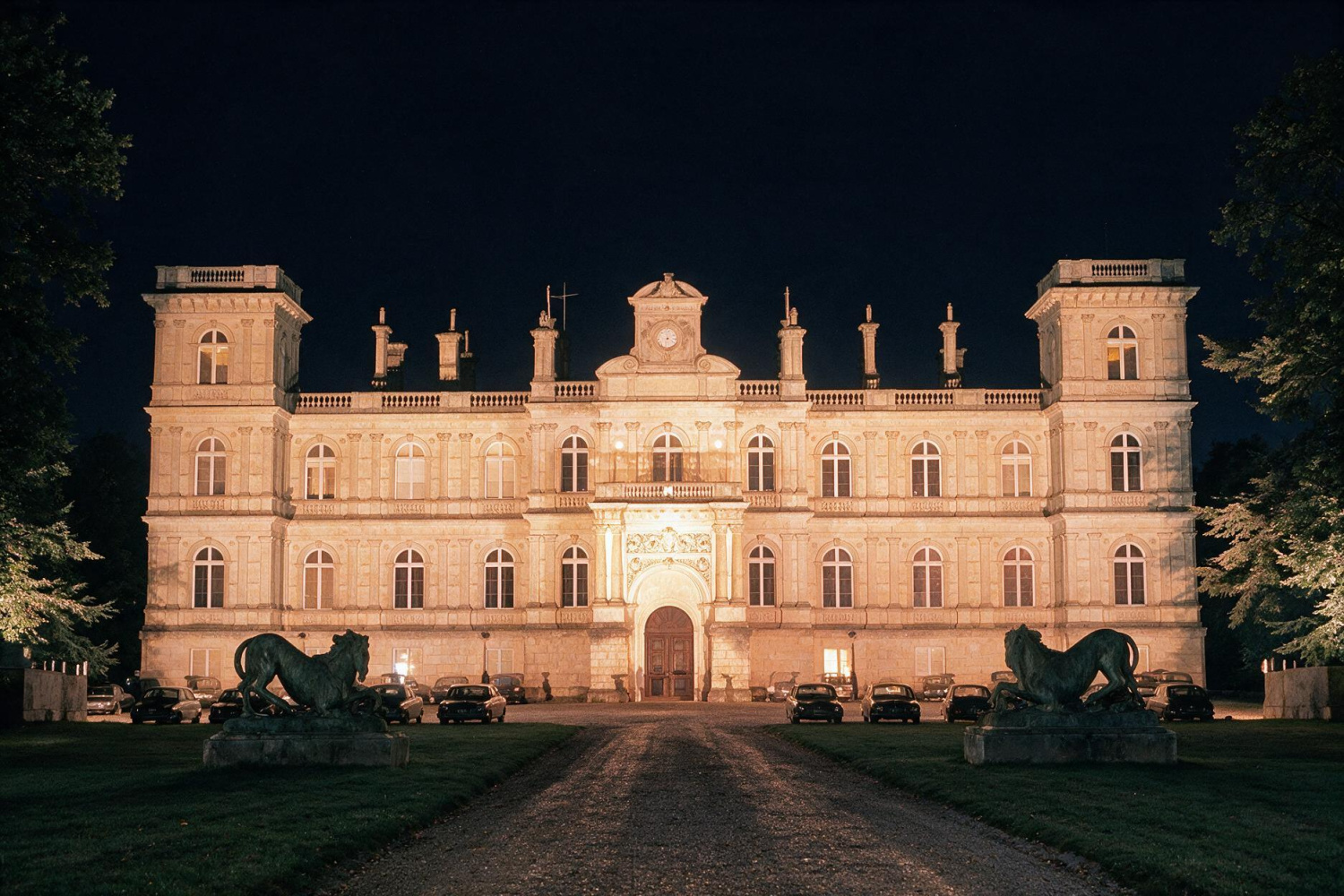
The setting was the Château de Ferrières in Seine-et-Marne, the vast neo-Renaissance pile put up by James de Rothschild — a house whose founding brief is one of the great sentences of nineteenth-century architecture. Having seen his cousin's Mentmore Towers in England, James is supposed to have told his architect to build him a Mentmore, twice the size. He got eighty guest bedrooms and thirty square kilometres of forest.
Occupied in the Franco-Prussian War, occupied again by the Germans, the house stood empty until 1959, when Marie-Hélène de Rothschild took it in hand. She had married her third cousin Guy, head of de Rothschild Frères, in 1957 — a match that cost him the presidency of France's Jewish community, since she was Catholic and it was the first such marriage by a leading Rothschild, and cost her a special dispensation from the Pope. A woman who has already negotiated with the Vatican in order to get married is unlikely to be daunted by a seating plan.
And she was, by every account including the reluctant ones, the finest hostess in Europe. Ferrières became the hedonists' capital of the continent: Yves Saint Laurent beside Brigitte Bardot beside Grace Kelly. So fierce was the competition for a card that one figure in society is said to have threatened suicide if she were not invited to the next one.
Baron Alexis de Redé, her closest collaborator, put his finger on the reason: none of it, he said, was achieved by charm alone. It required a degree of ruthless determination, and she attended to every minute detail.
She would need it. What she was proposing was not a fancy-dress party. It was a total work of art with a guest list.
The labyrinth
The first thing you saw was the fire. Ferrières had been floodlit with moving orange lights so that the whole palace appeared to be burning as you came up the drive. One arrives at the grandest house in France; the house is in flames; one goes in anyway. Surrealism, in a single gesture, and it hadn't cost her a word.
Inside, the staircase was lined with footmen dressed as cats, arranged as though they had fallen asleep in various attitudes. Then came a labyrinth of black ribbons hung to resemble cobwebs — a small hell to be traversed — from which the occasional cat would emerge to rescue you and lead you through to the tapestry salon.
There the hosts were waiting. Guy wore a hat with a still life on a platter. Marie-Hélène wore the head of a great stag, weeping tears of diamonds. The New York Times had her as a stag at the kill, towering antlers, pear-shaped diamond tears down the face.
The room she had assembled was arguably the last time such a room could be assembled at all. Audrey Hepburn. Salvador Dalí. Brigitte Bardot. Hélène Rochas. Yves Saint Laurent. Hepburn came with her head shut inside a Magritte birdcage. Alexis de Redé wore a four-in-one mask crawling with scarab beetles — an Egyptian gloss on Titian's Allegory of Prudence. Hélène Rochas wore a gramophone.
One guest hid her face behind an apple, for Magritte; another wore a collage of chopped-up Mona Lisas. Dalí designed several of the costumes and, with immaculate logic, wore none himself.
The table was worse, or better. Fur-covered plates. Taxidermy among the centrepieces. A dessert in the shape of a mannequin. To eat off fur is a genuinely unpleasant idea, and Meret Oppenheim had made it famous in 1936; to make three hundred people do it, in white tie, is either the greatest piece of hostessing of the century or an act of aggression. Marie-Hélène, one suspects, saw no difference.
What became of it
Three years later the Rothschilds gave Ferrières to the chancellery of the universities of Paris and withdrew to a house they had built in its woods. The party palace became a gastronomic school. As de Redé said afterwards, such things cannot be repeated now, for many reasons, though it remains fascinating to look back on occasions that had commanded one's thoughts for months on end.
The relics have gone the way of relics. In 2024, the gramophone headpiece Hélène Rochas had worn — the work of Hector Pascual — went under the hammer at Julien's for $2,600. Two and a half thousand dollars. One has paid more for a handbag with no gramophone on it at all.
And the ball itself passed into myth, where it has been treated very badly indeed. Its imagery is regularly said to have inspired the masked orgy in Kubrick's Eyes Wide Shut, though no connection has ever been confirmed — the resemblance is real enough, and Marisa Berenson, later Kubrick's Lady Lyndon, was in the room. More corrosively, the Rothschild name has made the evening a fixed point for conspiracy theories, which flourish on social media to this day. The chequered floor is sometimes offered as proof of Freemasonry (which would make most freemasons laugh); the cats and the antlers as proof of something darker. It is the oldest libel in Europe wearing a new hat, and it deserves to be named as such rather than tutted at.
What actually happened at Ferrières on 12 December 1972 was that an exceptionally clever woman with an unlimited budget and forty years of Paris in her address book spent months building a dream, and then invited two hundred people to walk through it in evening dress.
There was no message. There was no cabal. There was a burning house that was not burning, a cat that was a footman, a stag that was a hostess, and a plate you could not eat from.
The Surrealists spent the 1920s trying to smuggle the irrational into daylight. It took a baroness in Seine-et-Marne to serve it at dinner — and then, with a hostess's perfect timing, to hand the house away and never do it again.
The heirs of Ferrières
For all the talk of its being unrepeatable, the attempts began almost at once and have never stopped. Every few years someone announces a new surrealist ball — in a Venetian palazzo, a Belgian church, a Los Angeles ballroom hung with cobwebs — and it is called, sooner or later, "the new Rothschild ball". The comparison always flatters the newcomer, and always tells only half the story. Some of the pretenders fall pitifully short. One or two, in their own strange way, out-did Marie-Hélène at her own game.
The most ambitious of them all is now itself a memory. Gala Nocturna, the creation of the Belgian-German artist Viona Ielegems, was for a decade the largest costumed ball in Europe, and it never kept still — summoning its guests each year to a stranger setting than the last: a neo-gothic church hidden in a park, a baroque one in the heart of Antwerp, the Belle Époque ballrooms of the city zoo, palaces in Ghent and Brussels, a whole rented monastery, and finally the Venice Carnival.
Eight hundred came from across the world, some in costumes worth tens of thousands of pounds; several members of this Club were among them, and speak of it still.
Then Ielegems and her husband retired to a castle in Germany and quietly wound it up, toying with other schemes that never caught the same fire. Like its great model, it was a conjunction briefly sustained and then, with a certain grandeur, let go.
Two of its cousins are still very much alive.
The Labyrinth of Jareth in Los Angeles, a faerie-and-goblin fantasia named for the masquerade in the 1986 film, has run every year since 1997 and now packs five thousand costumed dreamers into a downtown hotel.
The Endless Night Vampire Ball, founded in New York in 1996 and staged each Halloween in New Orleans and a dozen cities besides, crosses Venetian carnival with a midnight rite and has been called, straight-faced, the best Halloween party on earth. Both are made with real craft and real devotion. Both, like Gala Nocturna before them, sell tickets.
And there, in two words, is the whole of it.
Marie-Hélène de Rothschild did not sell tickets. You could not buy a card to Ferrières, could not apply, could not talk your way in — which is why a woman of society was said to have threatened her own life rather than be left off the list, a compliment no ticketed event has ever been paid.
That exclusivity was not a dress code but a form of power, and it came with two things money still can't buy: the actual Dalí, cutting the actual cloth, rather than a hired hand dressing three hundred guests as Magritte; and the innocence of going first, with no legend to honour and no photographs to live up to. One cannot arrange to be the first. Marie-Hélène was, and everyone since has had to be second.
Yet it would be snobbery, and untrue besides, to leave the survivors there as mere echoes, for they have two things Ferrières never troubled to acquire. They are democratic — a gifted seamstress from Ghent who has never so much as glimpsed a baroness can, with her own two hands and a winter's work, out-dress a duchess on any of their floors and be photographed doing it — and they last, which Ferrières never meant to, coming round year after year and gathering a tribe that grows.
What Marie-Hélène bought with exclusivity, Gala Nocturna bought with scale, and the Labyrinth buys with sheer stubborn devotion; all of them feed the same faintly disreputable appetite, older than any of them, to put on a mask, walk into a room made strange, and be for one night considerably more interesting than one is at breakfast.
So, have we seen the last eccentric ball? On the evidence, we doubt it. Somewhere a hostess we have not yet heard of is already at her desk, pricing the taxidermy and the diamond tears and planning something to make Ferrières itself look thrifty — and printing her invitations backwards, to be read in a mirror. Or two! A nation of eccentrics can only hope to make the list.

Comments (0)
No comments yet.
Commenting is for subscribers. Sign in or subscribe to join the conversation.