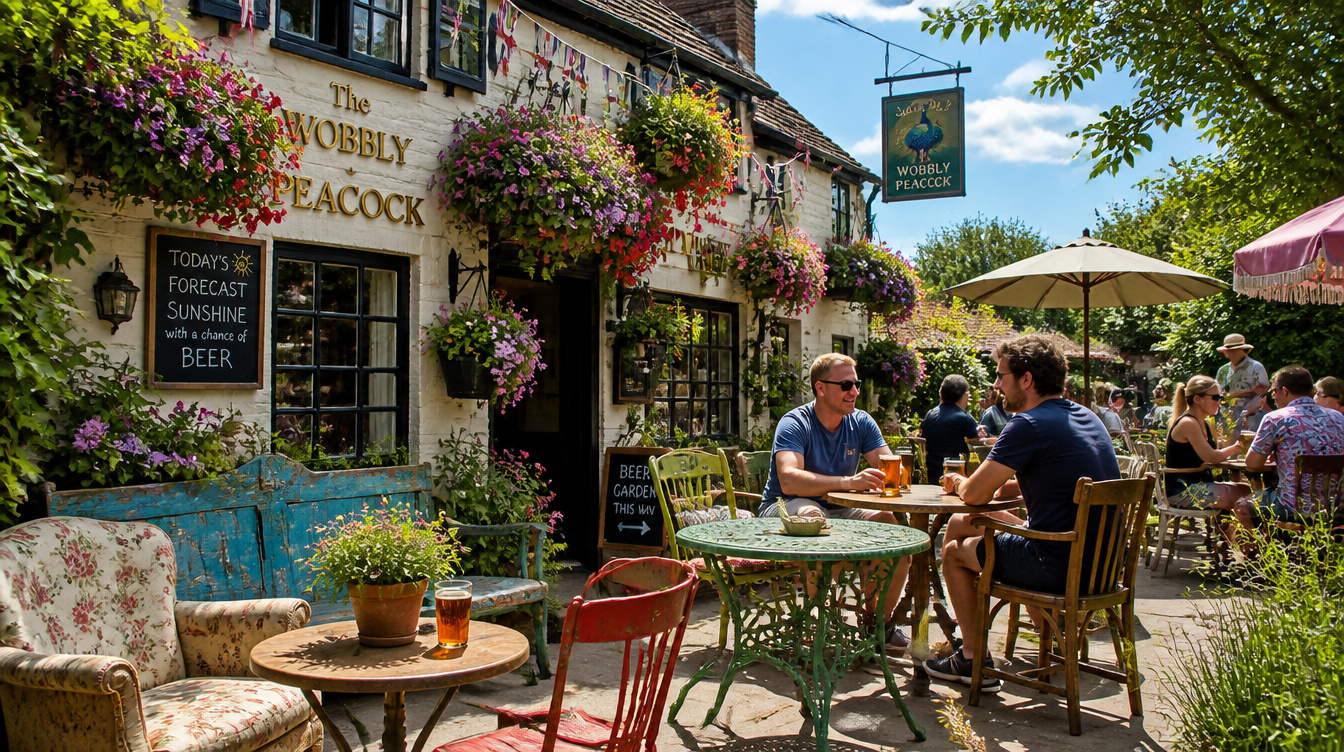
In 2010, a pub forum asked whether the eccentric landlord was a dying breed. Sixteen years later, every pub on the list can be checked. This is what happened to them, and to two men who went to the great Pub Above this summer.
The corner of Greek Street and Romilly Street carried, for many years, a sign identifying the establishment beneath it as the property of London's Rudest Landlord. The claim was not local folklore that had attached itself to the premises. It had been commissioned by the man himself, who also had it printed on the matchboxes, and who titled his memoir of 1991 You're Barred, You Bastards, on the reasonable grounds that this was the sentence his customers heard most often.
Norman Balon died on 4 June, aged ninety-nine. He had begun behind the bar of the Coach and Horses on 3 February 1943, at sixteen, walking out of school that morning because his father had taken the tenancy the day before. On his first night in the building, by his own account, a hundred and forty mice were caught. He retired in 2006, having served the same corner of Soho for sixty-three years, and having become, somewhere along the way, teetotal.
Weeks later, in Tadcaster, a Union Jack was lowered to half-mast above a red-brick brewery for another man: Humphrey Smith, dead at eighty-one.
Rudeness as a form of membership
 Balon's obituaries dwelt, understandably, on the insults.
He barred writers, tourists, the merely dull, and on at least one celebrated occasion his own mother, whom he judged boring and past it.
Sentences were usually commuted after a few days, the offender permitted to reappear to a rolling of the eyes. He was, he told an interviewer, rude by nature and possessed of no patience for anybody, and there is no reason to doubt him.
The insults are nonetheless the least interesting thing about him, and they are certainly not what filled the pub. The Coach and Horses was crowded because Private Eye worked round the corner and held its fortnightly lunches upstairs, beneath wallpaper that everyone who saw it remembered with horror. It was crowded because Jeffrey Bernard drank there and wrote about it in The Spectator until a West End play was set in the room. It was crowded because Michael Heath drew it, and because Lucian Freud went, and Francis Bacon, and later Jarvis Cocker.
And it was crowded because Balon's rudeness was not the rudeness of bad service. It was the rudeness available only between people who already belong to something. One cannot insult a stranger in any way that signifies; the transaction requires prior membership. A customer who was barred had first to have been admitted, and being barred from the Coach was a distinction people boasted about for the rest of their lives. Nicholas Lezard, who once lived above the bar, described him as the Hebrew Bible divinity, an authority not always susceptible of explanation.
The proof arrives at the end, where it usually does. When Bernard grew too ill to leave his flat, Balon carried lobster salad round to him and sat with him in hospital. The faculty that produces the insult and the faculty that produces the lobster salad are the same faculty. It is called paying attention.
Auntie
For the opposite temperament arriving at the identical result, consider Mabel Mudge, who came to the Drewe Arms at Drewsteignton in 1919 and finally gave it up in 1994, at ninety-nine, believed to be the longest-serving licensee in the country. Seventy-five years, one pub. Everybody called her Auntie.
The Drewe Arms has no bar, and never had one in her time. Drinks were ordered through a little hatch to the tap room and drawn straight from the cask, and the customer carried the glass back to a bench against the wall himself. The interior — cob walls, thatch, seventeenth-century woodwork surviving here and there, no modernisation to speak of beyond the eventual arrival of electricity and running water — now sits on CAMRA's inventory of historic pub interiors and is listed Grade II, largely because Auntie declined for three-quarters of a century to have any of it improved. She was not rude. By every surviving account she was the reverse. But the room belonged to a person, the person had views, and the drinker fetched his own pint from a hole in the wall because that was how it was done and there was an end of it.
The census of 2010
In the spring of 2010, on a forum attached to the pub directory Pubs Galore, somebody opened a thread called Eccentric Landlords and invited nominations. It ran for a fortnight. At the end of a long and affectionate reminiscence, one member put the question directly: were eccentric landlords a dying breed, or already a dead one?
Nobody answered him at the time. The thread simply stopped. But it left behind a dated list of names, which means that sixteen years afterwards the question can be settled by the straightforward method of finding out what became of each of them.
Gerry O'Brien, the Churchill Arms, Kensington. Remembered on the forum for calling last orders on a squeezy car hooter, and hoped to be still in post. He was. O'Brien came over from County Clare at sixteen in 1967, worked his way through the Prince Regent and the Coach Makers, and took the Churchill Arms in 1985. He then buried the building in flowers — something in the order of a hundred tubs, forty-two baskets and forty-eight window boxes, at roughly £25,000 a year — until it won an award at the Chelsea Flower Show, which no other pub has managed. At Christmas he hung ninety trees and twenty-one thousand lights on it. In 1988 a Thai regular called Ben talked him into being allowed to cook, and the Churchill Arms became, in all probability, the first pub in London to serve Thai food. O'Brien retired in 2017 after thirty-two years and went home to Ireland, handing the keys to his general manager.
Alan East, the Yew Tree Inn, Cauldon. Nominated as a serial hoarder who had filled his pub floor to ceiling with antiques and junk, which is accurate and considerably understates it. East took the pub from his mother and has been there upwards of fifty years. His own phrase for the result is unimprovable: a museum with a licence. Eight restored polyphons, which are Victorian coin-operated disc players and still take your tuppences; a Grecian urn; penny farthings and bone-shakers; Jacobean settles, and church pews; a serpent; an Acme Dog Carrier; and two pairs of stockings said to have belonged to Queen Victoria. No television of any kind. A tortoise called Colin. His stepson took over the running in 2013, and East is still in the room.
Trevor Wallis, the Bowling Green, Otley. Described as the most bizarre pub the nominating member had ever entered: last orders sounded on a hand-wound siren, a table top made from a coffin lid, and a landlord with more outfits than Mr Benn. Wallis and his wife Judith gave it thirty years and retired in 2006. The pub shut that August and the hoard went under the hammer in September — a full-size crocodile, assorted other taxidermy, clocks, musical instruments, aircraft propellers. The Grade II listed building, put up in 1757 as assembly rooms and used at various times as a chapel and a courthouse, was granted permission for conversion to flats, and was then bought instead by J.D. Wetherspoon. The member who nominated it had appended a parenthetical guess that this was where it would end up. He was right.
Robert Whigham, the Red Lion, Stodmarsh. Remembered fondly for being several drinks into the afternoon by the time visitors arrived, and for the ducks and chickens wandering in from the garden. Whigham appeared in a Channel 4 documentary in 2009 and told it he drank fifteen pints a day, beginning with a sharpener at eight in the morning, and that he had always been a lovable drinker. He died in 2016 at sixty-six. The pub reopened under other people, served foraged squirrel for a while, and was boarded up without notice in September 2022.
Doris Jemison, the Red Lion, Snargate. Not nominated, but invoked: one member complained that the documentary had somehow overlooked it. He was right to complain. The Jemison family have held the pub since 1911. Doris arrived in 1947 as a Women's Land Army girl, married into it, and ran it for over fifty years until her death in April 2016 at eighty-seven. The building dates from around 1540 and has not been redecorated since 1890 beyond an occasional lick of paint; it is on CAMRA's National Inventory, the ale comes by gravity from the cask because the handpumps on the marble counter are ornamental, and her wartime memorabilia is still up. In her last years she sat quietly in the corner with her knitting while her daughter served. It is still called Doris's. It is still hers.
Five pubs. Five successions, all in one direction. Two continue under family, one under a brewery's employee, one is a chain outlet, and one is boarded up. The man who asked the question in 2010 has his answer, and it is not the one anybody wanted.
The saloon bar, uncorroborated
The same thread carries a good deal that we have been unable to confirm. We are printing it anyway, clearly marked as gossip and hearsay, because the one rule that matters with a rumour is that you say it is one.
So: the landlord of the Old Mill at Plumstead is said to have called last orders on a drum kit, and the guv'nor of the Village in Salisbury on a very loud train horn. A landlord known to his regulars as Dolphin Doug supposedly ran such a reliable line in insults that people came from miles around to collect one, and would have bought the T-shirt if anyone had printed it. One licensee is reported to have cleared his bar at closing by letting two Alsatians into it. Another is said to have kept a reject button for the jukebox behind the counter, so that a regular who picked a bad record would hear a taxi being called for Mr So-and-So before the track was cut off. And in Wellington, two pubs were apparently known to everyone by their landlords' names rather than their own — which is the highest honour the trade can pay a man, and one he cannot ask for.
We have checked none of it, but believe most of it.
Tadcaster
Which brings us to the difficult case, and to a correction this magazine is obliged to make to its own instincts.
Humphrey Smith owned Samuel Smith Old Brewery, founded in Tadcaster in 1758 and the oldest in Yorkshire, together with some two hundred pubs. He was reclusive to a degree that verged on the theatrical: almost no interviews, almost no photographs, a company that simply declined to answer the press. He kept the Yorkshire square fermenting system, employed resident coopers, and sent out local deliveries behind dray horses. He built an export trade in the 1980s that did a great deal to introduce American drinkers to porter, oatmeal stout and brown ale. Jonathan Neame of Shepherd Neame, paying tribute, called him a unique character in the industry, and was not merely being polite.
His pubs permitted no music, no television, no mobile telephone, no laptop, no electronic device of any description. The company website described them as havens from the digital world, which for a substantial constituency of drinkers is exactly what they were, and whose loss would be a real one. Children were barred. So were dogs. So, in a designation that has passed into legend, were bikers, as undesirables. Swearing meant eviction.
That is the eccentric proprietor in his purest form: no committee, no policy department, no shareholder to placate, absolute personal control over two hundred rooms. The results are on the ground for anyone to inspect. Something close to half the estate is shuttered. The Angel and White Horse, the flagship, stands empty in Tadcaster itself. The Shoulder of Mutton in Bradford, trading since 1825, was locked without explanation in 2024; the local CAMRA secretary called it part of a pattern, and nobody at the brewery contradicted her.
The mechanism was personal inspection. At the Fox and Goose in Droitwich Spa, Smith heard a customer swear and closed the pub, which left the licensees without a job and without a home on the same afternoon. At the Cow and Calf in Sheffield, the couple running it were dismissed after failing to produce his preferred pudding.
Yarde Down
Now hold that rulebook up against another one.
 The Poltimore Arms sits on Exmoor, between North Molton and Simonsbath, in a hamlet called Yarde Down with a resident population of two. It has no address, only grid coordinates. It is entirely off-grid: no mains water, no mains electricity, no gas, the water piped down from a spring on the hill with frogs in it. There is no television, no Wi-Fi, no fruit machine, no jukebox, no telephone and no website. Its landlord, Steve Cotten, is a registered-blind former manufacturing engineer who ran the village shop at Bratton Fleming before taking the pub on, and who has been christened Britain's Grumpiest Landlord by roughly every newspaper that has found the lane.
On a schedule of prohibitions, the Poltimore Arms and a Samuel Smith's house are very nearly the same establishment.
They are, in every way that signifies, opposites. Cotten's customers pull their own pints and serve behind his bar. They let themselves in for tea at whatever hour they want it. A regular who fancies cooking announces it on the pub's WhatsApp group and comes over to do so. There is no till discipline worth the name: at the end of the night, or the following day, you hand him roughly what you think you owe. His summary of the arrangement is the sentence the whole argument turns on — everyone knows it is not his pub, it is everybody's pub. He happily concedes that nobody else speaks to his regulars the way he does, and his regulars keep coming down an unmarked lane to be spoken to.
The best illustration is the summer the beer garden became an aerodrome. A customer known locally as Dangerous Dave took to flying drinkers on short circuits over the moor in a two-seater when conditions allowed, charging for petrol; the pub renamed itself Yarde Down International, put up wind socks, installed radio equipment and reconstituted the bar as a departure lounge. The first passenger was ninety years old. Exmoor National Park Authority wrote requesting a site visit on the question of change of use, and Cotten described the reaction as ridiculous, which it was.
Note where that eccentricity originated. It was not decreed from an office. It arrived through the door with a customer, and the landlord had the wit to host it.
Cotten went on to stand for Parliament as an independent in 2024, on the platform that his instructions would come from the people in his bar. He was not elected, which is a pity, because his diagnosis of the trade is better than most of what is offered in Westminster: pubs are shutting because they are worth more as houses, and the remedy is to refuse planning permission for the conversion.
The test
Our earlier instinct — that the eccentric landlord is being administratively dissolved by pub companies and policy documents — was not wrong, but it was lazy, and Yarde Down is the reason.
The variable is not eccentricity against corporate management. Cotten and Smith ran near-identical rulebooks. The variable is proximity, and consent.
Balon stood in his own room every night and paid for his temper in the only currency a publican has, which is whether anybody comes back tomorrow. Auntie Mudge's refusal to modernise was absorbed entirely by Auntie Mudge, and when the pub finally failed long after her death the village raised half a million pounds to buy the freehold back. Alan East has spent fifty years filling a building with objects nobody asked for, at his own expense, and people drive across two counties to look at them. Cotten is rude to people who have driven forty minutes down an unlit lane for the privilege, and who could stop at any time.
Smith governed two hundred rooms he did not stand in, arriving unannounced, and exported the whole cost of his convictions to tenants who had no vote, no warning and, in several documented cases, nowhere to sleep that night.
For most of the modern history of English licensing this was harder to do, for a reason of law rather than of manners. The justices granted the licence to a named individual, and that individual's name was displayed above the entrance because the statute required it. The building held no permission. A person held it, and the building merely housed him. The Licensing Act 2003 rearranged the furniture: the premises now carry a licence of their own, with a designated supervisor named and a personal licence sitting behind. Tidier, more transferable, and vastly more convenient for anyone operating an estate from a distance.
There are early signs of a thaw in Yorkshire. Smith's son Samuel has run the London houses for several years, closed pubs are reportedly being advertised for managers again, and the rules signs have come down at the Royal Oak in Tadcaster. York CAMRA, which has spent years receiving no reply whatsoever from the brewery, is hopeful, and makes the modest point that a drinker walking into a pub would like to feel welcome and be able to sit down.
The Poltimore Arms, meanwhile, has no name above the door, because it has no door number, no postal address and no sign that anybody driving past would notice. What it has is Steve, and a spring with frogs in it, and forty people who would not drink anywhere else.
Which is the whole thing, arriving from an unexpected direction. The sign was never the point. The point was that a name was on it, and that the person it belonged to was standing underneath.
Sources: obituaries and profiles in The Spectator, The Oldie and elsewhere; ITV News London; Camden New Journal; Difford's Guide; The Morning Advertiser; CAMRA's What's Brewing and National Inventory; BBC News; The York Press and Gazette & Herald; Kent Online and the Kentish Gazette; the Otley Pub Club; The Irish Post; Protz on Beer; Devon Live; The Daily Telegraph; South Devon CAMRA; ITV News West Country; and the Pubs Galore forums.
Norman Balon photo by Ian Freeman.
Comments (0)
No comments yet.
Commenting is for subscribers. Sign in or subscribe to join the conversation.